Author Archive

>The Lowdown On The Santa Fe

>

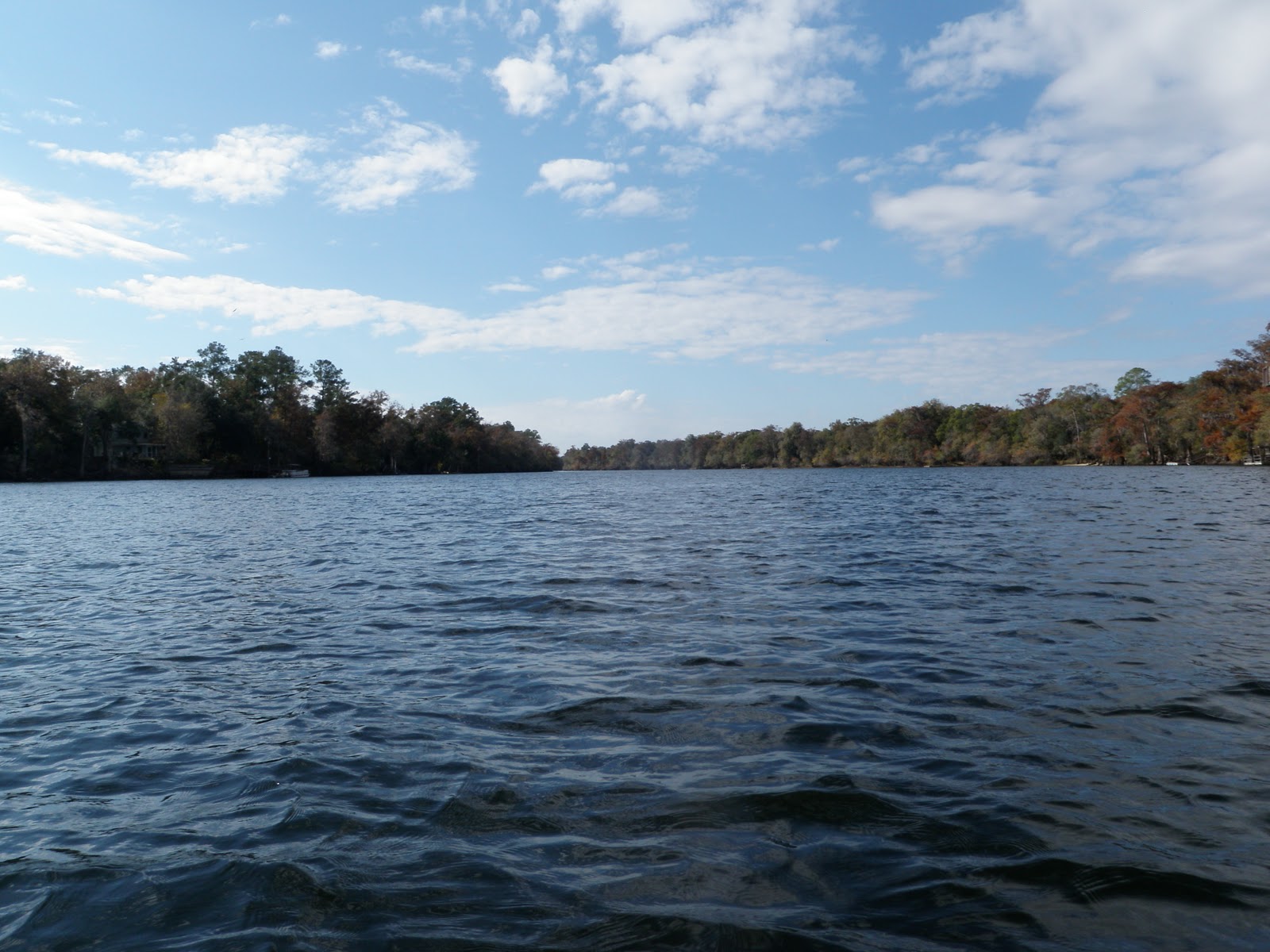
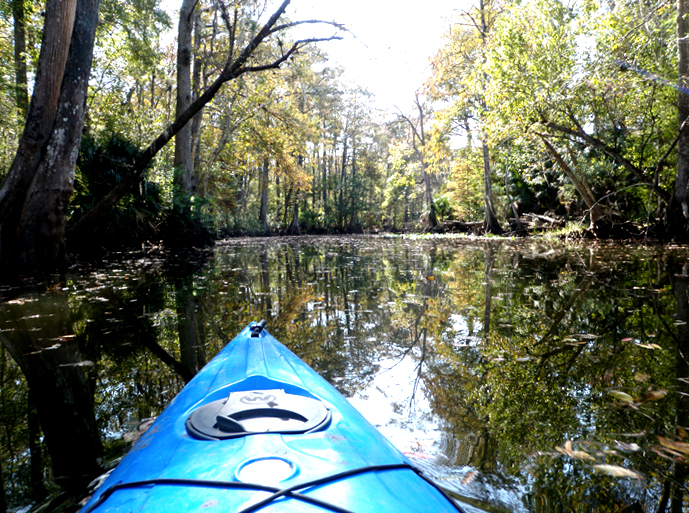
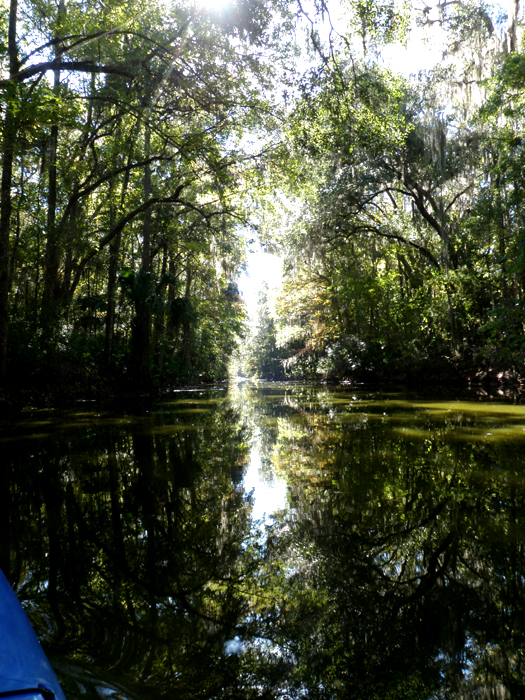
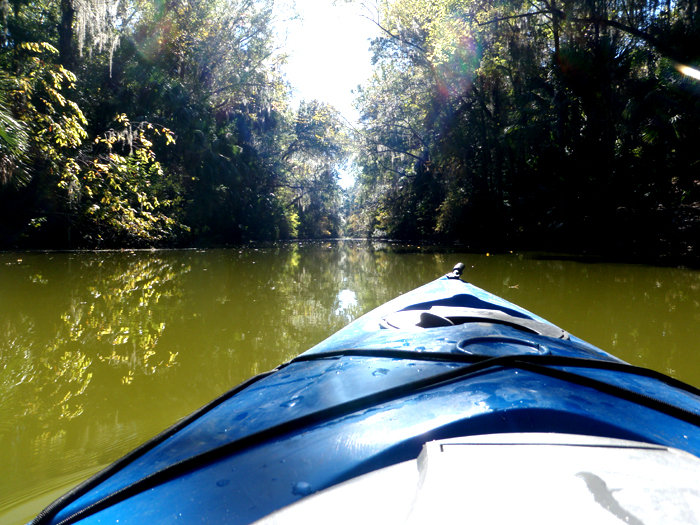
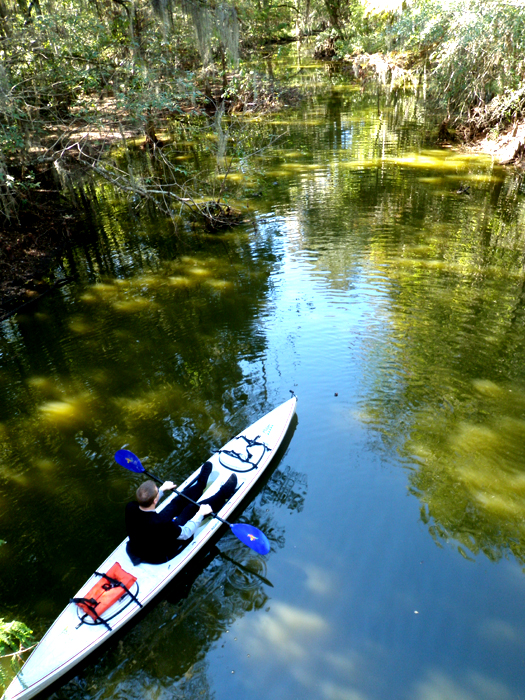
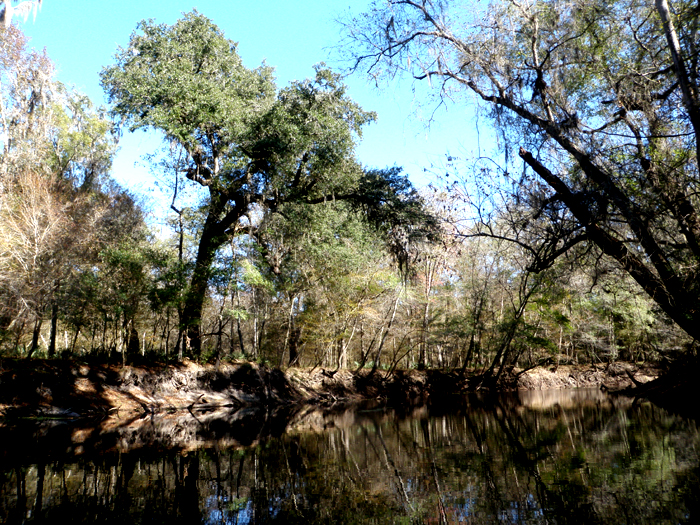
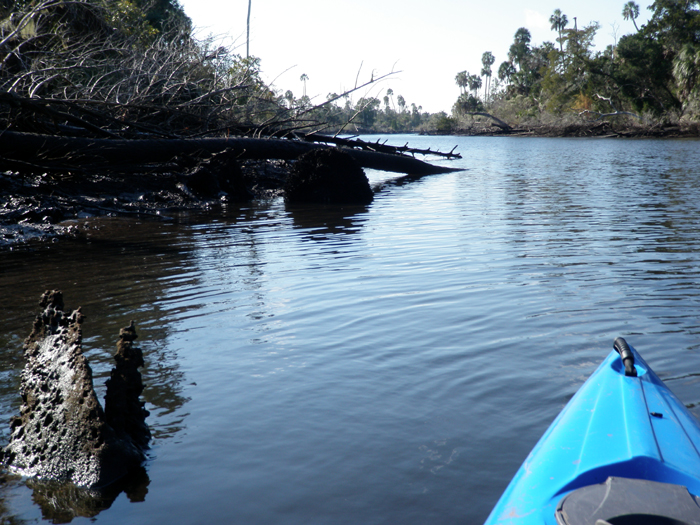
Someone pulled the plug on the Santa Fe River. Even the sinks are dry now. High bluffs, downed trees, and new “rapids” abound. I spent the afternoon bushwhacking, portaging, and documenting. I was here back in early October, and the difference between now and then could not be more stark. A sense of winter torpor has seized me of late, so I scheduled this outing like a doctor’s appointment (but without the ego-deflating weigh-in). If I had waited a week, I bet I could have walked along the river bed without getting my feet wet.
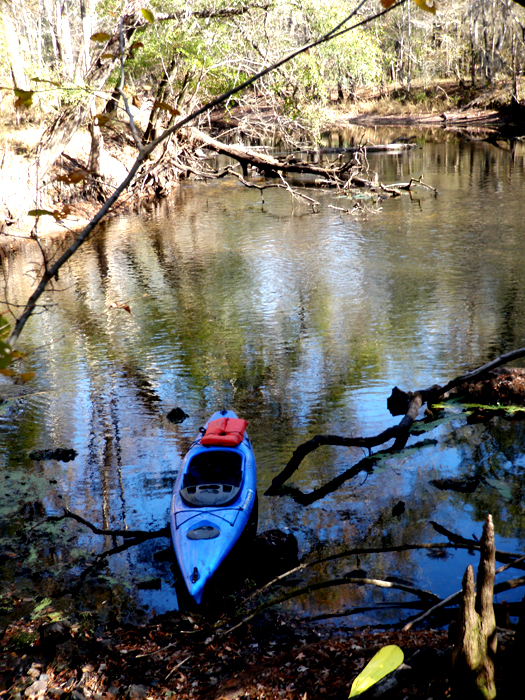
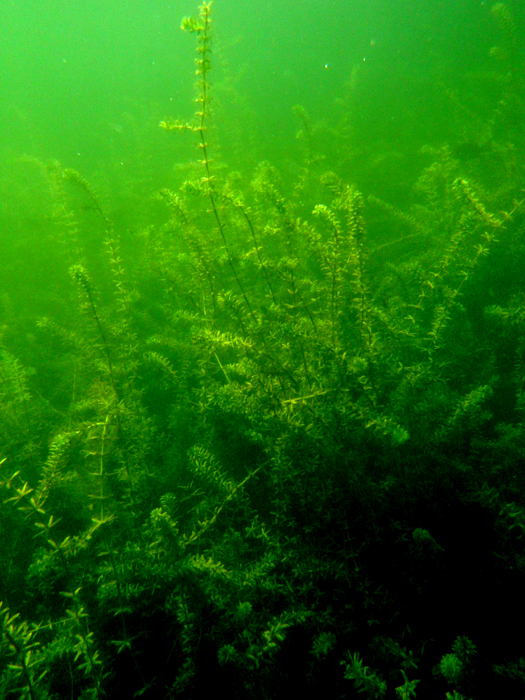
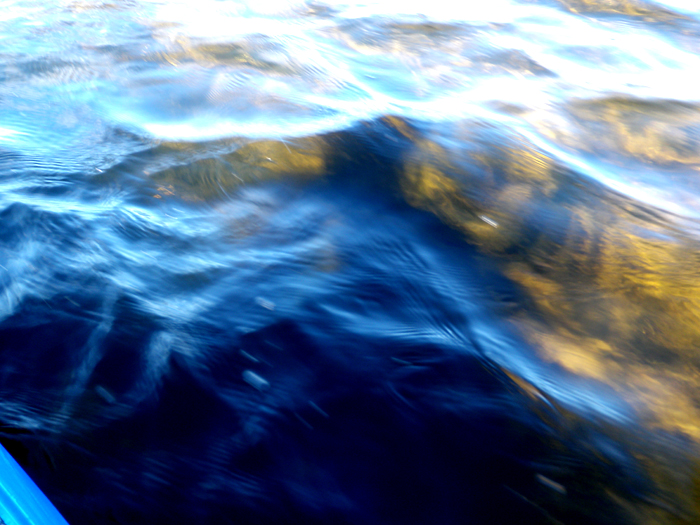
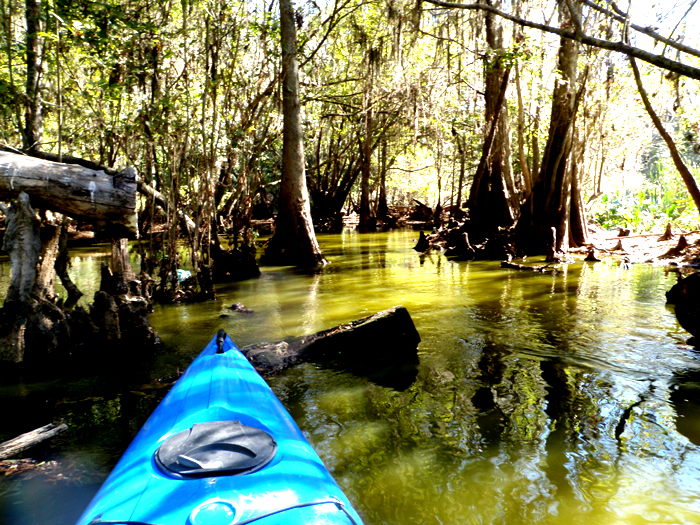
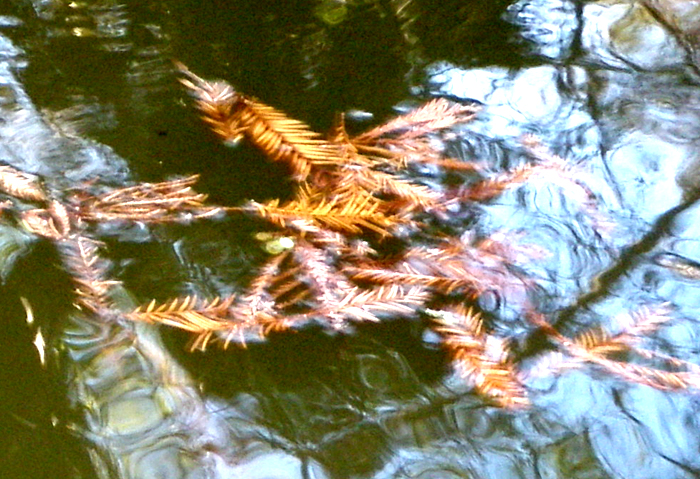
The new obstacles meant that I got a solid upper-body workout and I even “shot” the first “rapid.” That sound you hear? That would be runnels of blue plastic being stripped from the bottom of my boat by the exposed limestone. Portage on the way back, for sure. The last time I was here, I had to get out of the way of a house boat. Not this time. The water had become clear (or maybe it was before?). This meant that I could watch where the turtles go when they bail from their perch on the log at my approach, the wigs of algae waving in the current, and fallen leaves underwater glowing like new coins.
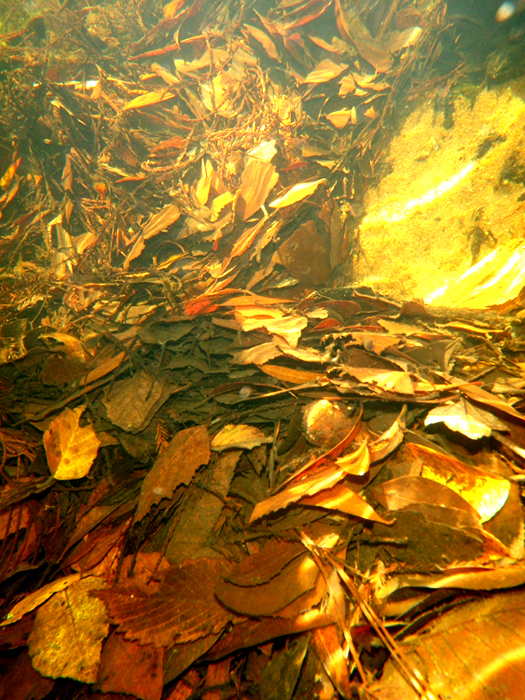
Underwater Leaves

Standing up in a kayak is a sketchy proposition. I recall one time in particular when I decided it was a good idea to moon my fellow paddlers during a jaunt down the Upper Withlacoochee and fell very quickly–and justly–into the water. But now I can walk up and down the deck like a Wallenda, and that comes in handy, as I’ve taken to exploring the land that lines the banks of my runs.


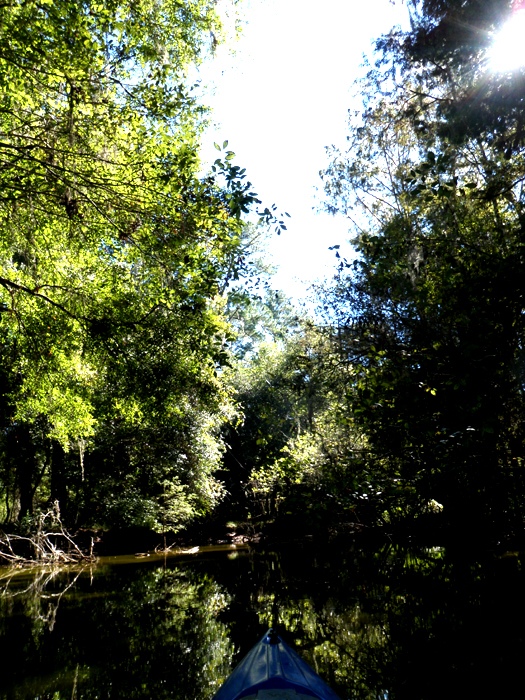
They say that any kind of daily practice contributes to spiritual awakening, and quite frankly I could use a bit of that these days. This part of the Santa Fe (between I-75 and O’Leno) is wild and lovely no matter what the water level and my spirit was enriched by moving through it today.

>The Waccasassa River After The Apocalypse

>

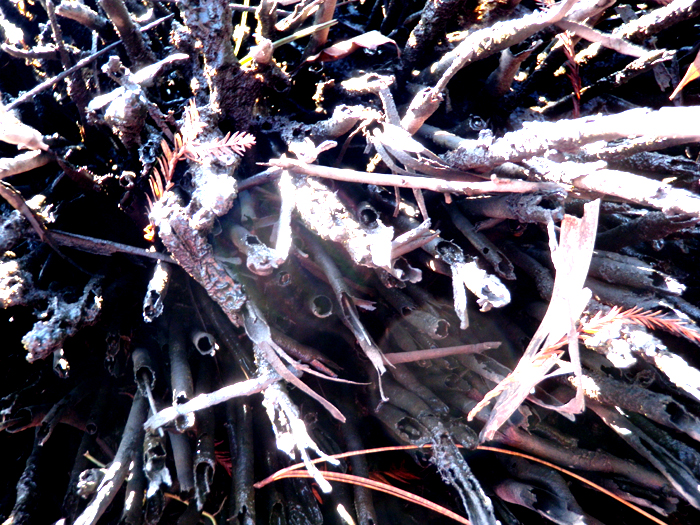
The boat ramp for the Waccasassa River is 38 miles from my house as the crow flies, but it might as well be on the moon. The river is wide and banked with soft, black mud and wasted trees, uprooted and pocked with woodpecker holes. Something came through here, a flood, a hurricane, a bulldozer, and although the parking lot was packed with trucks, trailers, fishermen, and one particularly grouchy old woman (yes, I grouched back), we saw almost no one on the river itself, except for alligator and birds.

It became apparent immediately that this place was tidal, and low ebb at that, because we paddled past the exposed roots of salt marsh grass and the aforementioned mud. At one point, after we turned into Otter Creek, I got out of the boat to see what lay beyond the banks (lots more marsh grass, by the way) and my sandal came off in mud the consistency of thick cake batter, several pounds of which I brought back into my boat with me.

I love this place. It seems endlessly discoverable and is only accessible by boat; the whole place is one big preserve. The gators we encountered, out for one last sunning before the deep freeze, reluctantly entered the water as we approached, no mean feat for a cold-blooded creature as the water numbed my hands in seconds. The stunning tree diversity along the banks adds to the otherworldliness of this place: oaks next to palms next to cypress. The Waccasassa is one of those places that could only be in Florida and it’s just down the road.


>How To Make Black Water

>

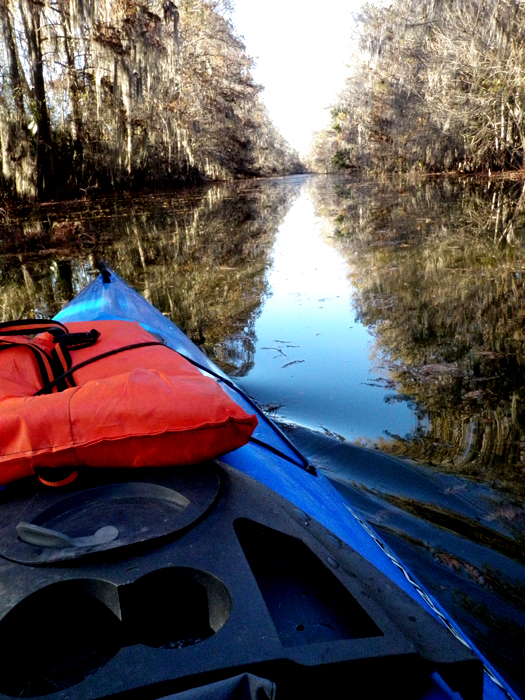
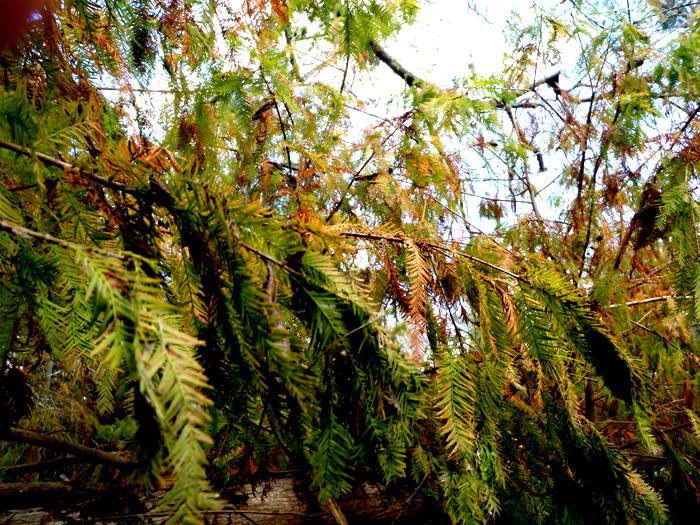
In my pre-paddling life, I somehow never learned that, as evergreen as they may look to you and me, cypress trees are deciduous. So watching them go from green to rust to dead has been a revelation. Now their needle-leaves either form carpets on the water or hang in black, webby clumps from the branches. At some point they will all drop, rot, and stain the water. Some call it tea-colored. I call it black. I become a bit wistful watching this happen so quickly. Were I listening to, say, Lou Reed’s “Berlin” at the same time, it might just do me in. 

I came out again to Camp’s Canal to find water moccasins. No luck there and a note to anyone paddling this time of year: get on the water by noon or you’ll be coming back in the dark. The gators too are nowhere to be seen either, having crawled back down into their hibernation holes for the winter. None of this apparently affects the ibises or Great Blues, most of whom still wonder why I keep coming back to their house uninvited. In the distance, I hear Sandhill Cranes and Barred Owls. The reverb in this place is unparalleled.

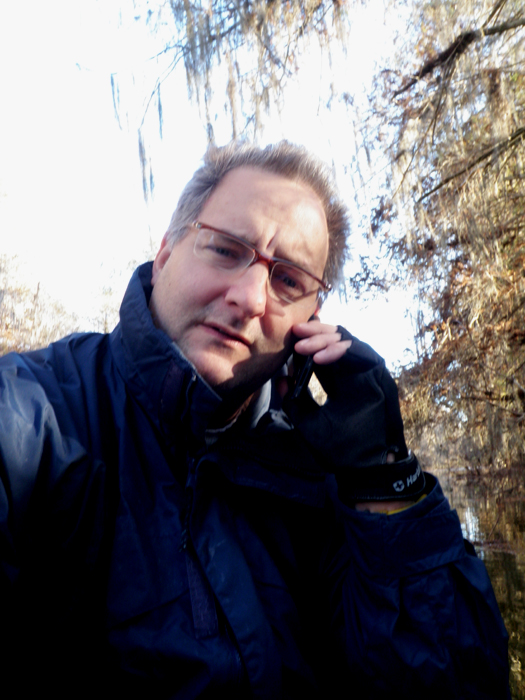
Against my better judgment, I’ve let my kayak become my new office, and I will from time to time take a call on the water. In fact, I end up taking a good bit of equipment with me now, mostly to keep it from getting stolen from the truck. In fact, your seeing these photos is nothing less than a miracle. I came back last night and could not locate my new waterproof camera. After tearing the house and truck up looking for it, I went back to the canal and found it nestled in the weeds next to the river bank. It spent the night out there, which is longer than I’ve spent on Camps Canal.

>Scattering Coots On Orange Lake

>

Then there are the times you have to make yourself go. Maybe it was a hangover from the 4-day weekend spent reassuring family and friends that I really was okay, really, and that I foresaw no trouble finding another job, when in truth it really did worry me. Maybe it was hearing all the cars outside my window going to work in the morning. Maybe it was the nightly work dreams where I am clearly trying to make sense of it all. Sometimes it’s just a matter of hauling the carcass out to the water to immerse myself in the changing and the changeless.

I’ve formed an emotional carapace over the years that serves me well in times like these. I can talk to store clerks, strangers, fellow paddlers, damn near anyone, and they have no inkling what is going on inside. This is good, in case you’re wondering. I used to be a book far too open and raw for anyone to want to read. Now I can be a person among people on my worst days. So it was that I was able to carry on a 30-minute conversation with a paddling couple just coming out of Orange Lake as I was heading in. They live on the Suwannee and spend their days kayaking and fishing and are both lean, tanned, and wiry. I wanted their life, but spent my time with them sharing a bit of mine.

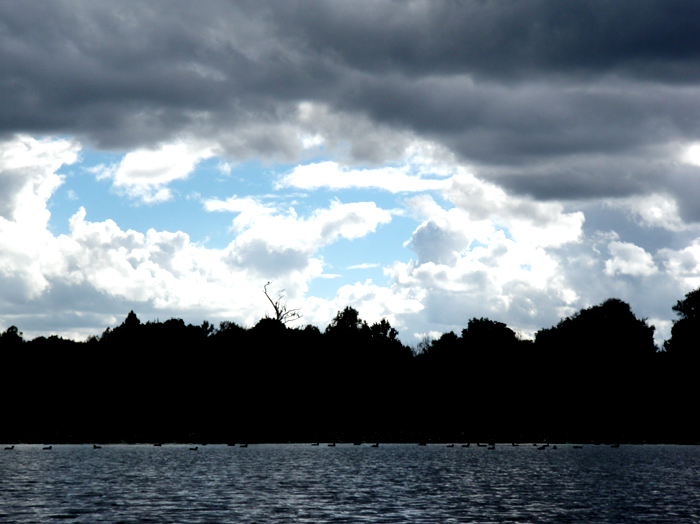
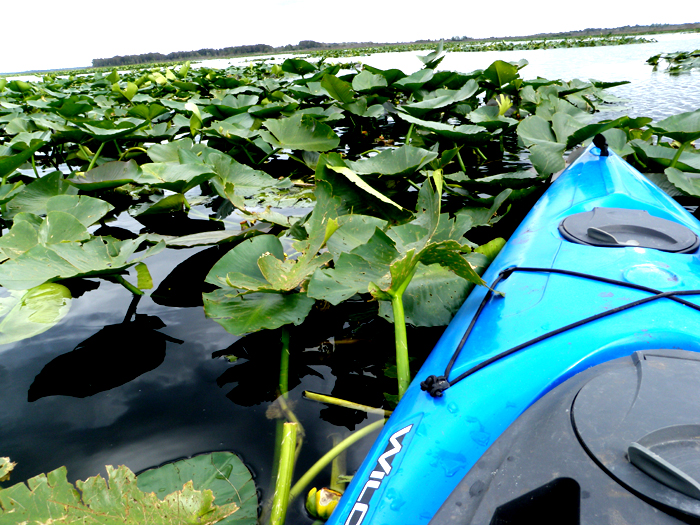
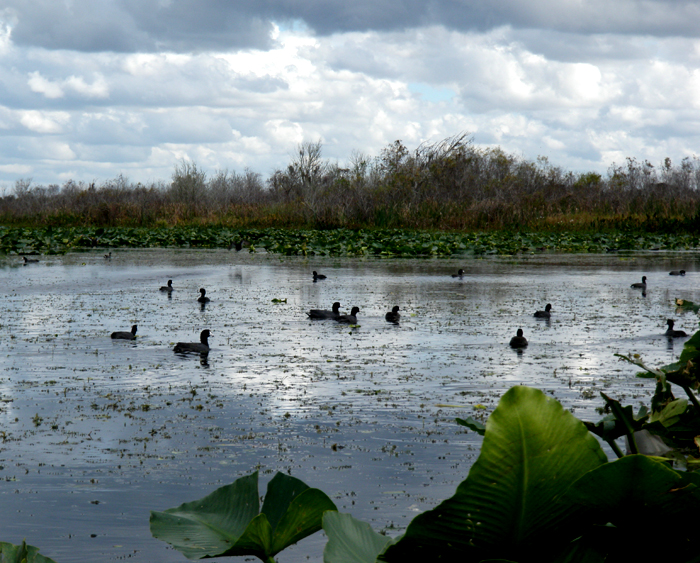
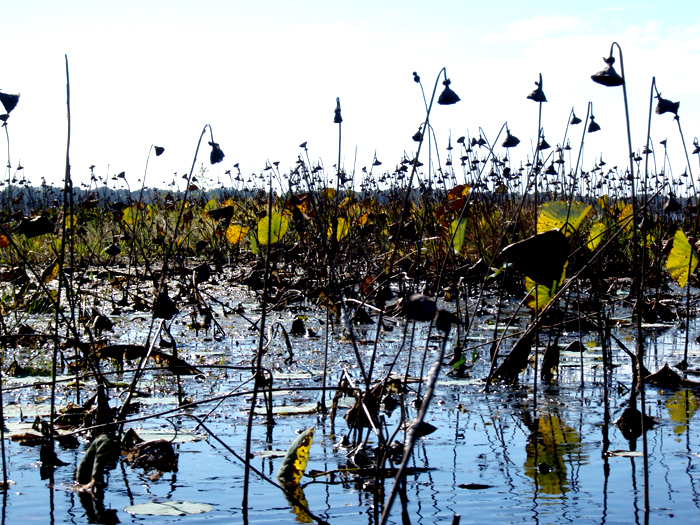
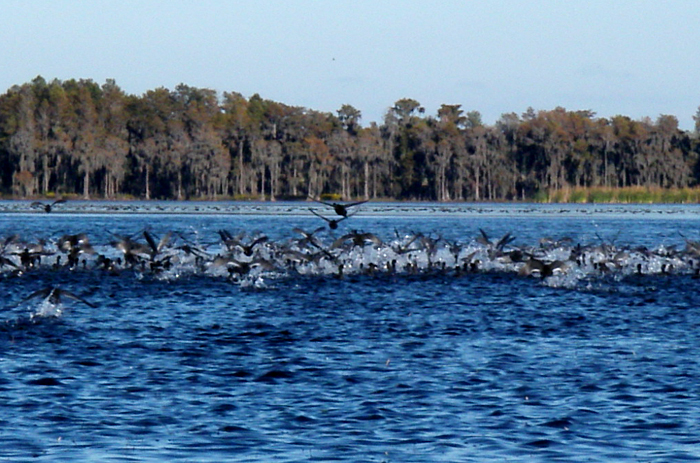
Orange Lake is now Coot Central and I spent my time out on the water steering between the spatterdock and making them take off and land over and over. I did not realize how loud they are until I closed my eyes to listen. Like midtown Manhattan. Orange Lake is a lake that wants to be a swamp or prairie. It does not seem to be shore-bound and is constantly draining through a hole in the aquifer. The result is a series of islands where you cannot actually trod, but you can’t see through them either. Orange Lake is a lake that used to be, but we will continue to call it a lake, because things like that don’t change.

>River Styx, A Graphic Short Story

>

>Chasing Vultures On The Suwannee

>

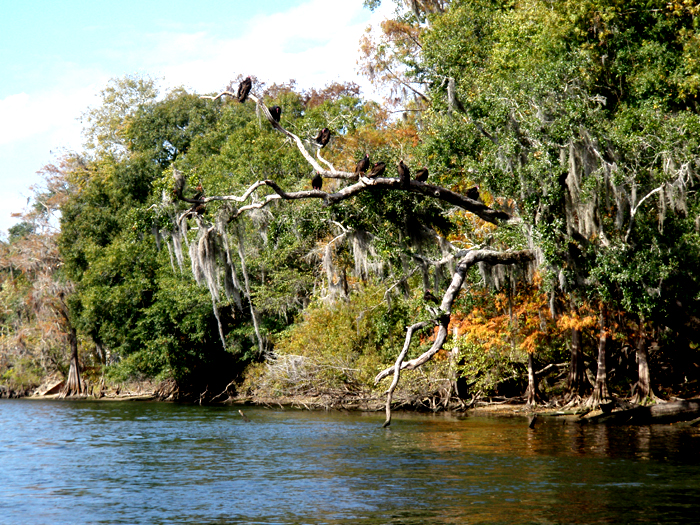
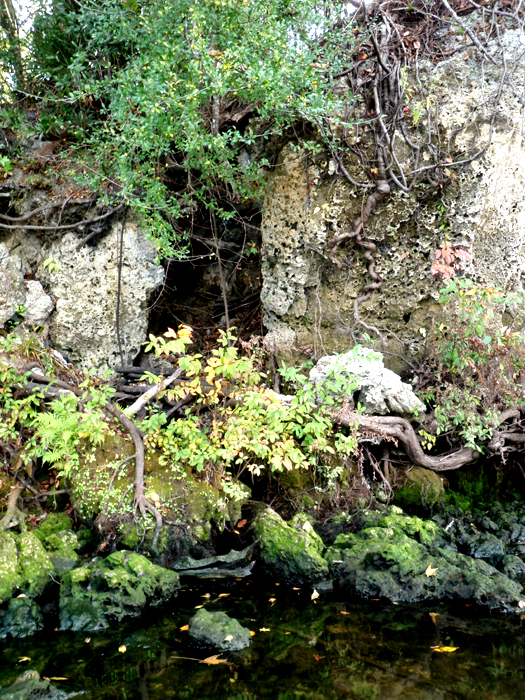
Anybody who’s spent more than 24 hours in this part of Florida has been on the Suwannee, so no trailblazing here. But when you’re down in the water, as you are in a kayak, you see things that people doing 40 knots between jumping sturgeon cannot see. For one thing, it’s a wide and freaky river with currents going both up and downriver. For another, its levels can fluctuate wildly, as the high fortresses that line each side attest. Also, a good bit of it is exposed limestone swiss cheese. I am not used to paddling under bluffs this high.

I’ve never seen this many vultures in one place either, both black and turkey. About 50 of them seemed to be circling a spot upriver, but as I moved closer the congregation seemed to move. I could get no closer. Some of them were so high up they became mere dots against the sky. But as I reclined in my kayak, a few of them circled over me, lower and lower. Vulture paranoia? Could be.

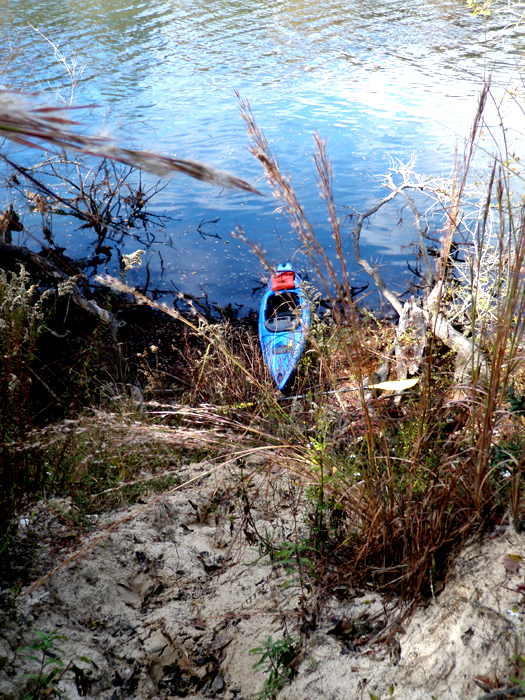
But I cannot pretend, even for the purposes of drama, that this is “Wild Florida.” I pulled up to the bank about halfway down and climbed the sandy bluff there to see what was on the other side. It was Highway 27, a mere 50 feet from where I stood. I should have known it was so close to the road, because I filled up the back of my boat with trash. Nevertheless, from my vantage point, I could see at least two currents in the river. I was counting on an effortless float back to the put in, but that was not to be. Hard work up and hard work back. Maybe this is a river for motorboats.


Back at the car, a state park worker drove up to talk, his face ravaged by skin cancer from years as a roofer. He was worker under a program funded by the stimulus for folks over 55. He decided to be a park guide. Pretty cool. He told me the park was one of the most lucrative in Florida, some 3.4 million dollars in revenue last year. I found that gratifying. Even with all the technology and other distractions, Big Ass Rivers still draw us to their banks.


>Rusty Trees On The Oklawaha

>

This is the part of the Oklawaha where no one goes: the fishing isn’t as good and water goes dark south of the springs. Of course, this is why I love it. I came here not too long ago, but it has since been transformed into an autumn canvas of floating leaves and rusty trees. I’ve never had the time to follow this river as far south as I’d like, but a camping trip along its banks is in the offing.

The swirling springs end as soon as you turn south from the Silver River and its hydrilla farms. Even mere drifting feels too fast to take everything in. I haven’t quite worked out paddling-with-others etiquette. Is it cool to paddle ahead occasionally? Do I over-explain river phenomena I’ve noticed? At any rate, some of the best conversations I’ve had have been on the river. Not the lake, not the Gulf. The river, every time. We naturally internalize its meandering, I suppose.

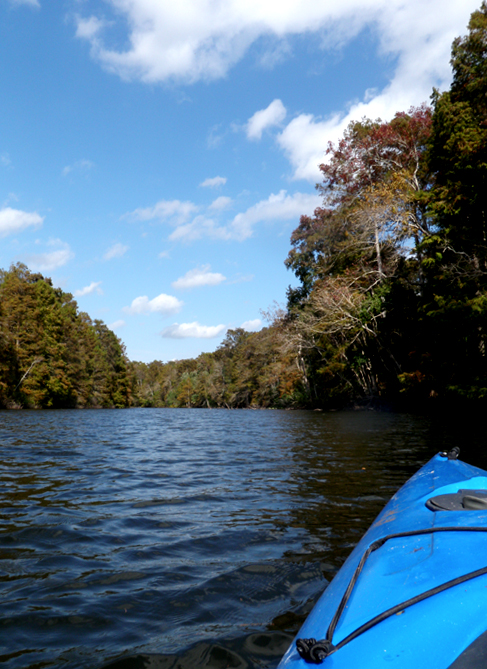
Cypress turns rusty in the fall. I never knew this until someone pointed it out to me the other day. I guess when you look at them every day, it’s hard to notice subtle changes. But here, the colors are obvious and unmistakable. Rust, green, and brown in the trees and black, sky blue, and green in the water, along with the occasional brilliant red leaf. The birds remain abundant here–ibis, cormorant, anhinga, herons–but the gators have gone…somewhere. I only saw one this time. I had come to love them and now miss seeing them.


I’m hankering for more than the three-to-four-hour surgical paddling strike. I have two relatively huge compartments in my boat and theoretically I could go out for a few days. I now have the time so why not? I welcome any suggestions and, in the meantime, look for some overnight tales in these pages.


>Camps Canal In Which We Gain A Few More Precious Feet Toward River Styx

>

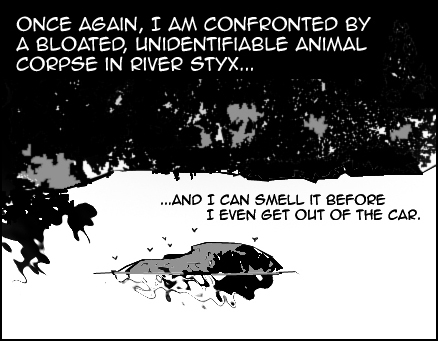
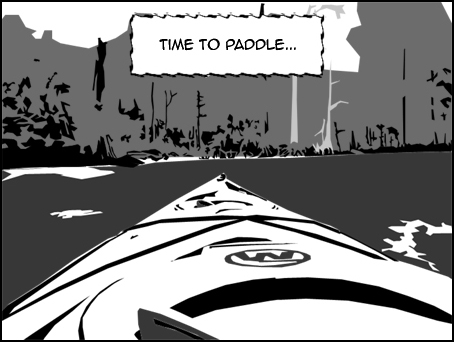
As I’ve mentioned before, getting from Newnan’s Lake to Orange Lake is the paddling holy grail in this area. As far as I know it has never been done successfully in modern times. Yet that has not stopped me from trying. As I see it, two problems areas remain unnavigable: a small stretch between Prairie Creek and Camps Canal and another longer stretch between Camps and River Styx. Evidence abounds of attempts to clear this portion in the form of sawed-off trees that now clog the channel. It is gratifying to see this same desire to break through in others, but I think it will take at five people who are willing to go on a do-or-die mission to accomplish this. I volunteer my services.

Nevertheless, this space between the lakes stands as the crowning jewel of Alachua County and I have been in few places more lovely anywhere in the world. The water is the color of jade and trees no less than 40 feet high line its banks. Old, broken bridges and water gates appear out of nowhere as markers of previous attempts to create and control its flow. In places the canal lines the swamp adjacent to Paynes Prairie where, in the case of today’s outing, we seriously pissed off a Great Blue Heron. “You kids get outta my yard!” it seemed to say.

My favorite places here are the “discovery” areas where one has to somehow move past debris to get to the next jaw-dropping space. Up to now I have moved through these areas almost completely ignorant of where I was geographically. Now I have a GPS that can actually pick up a signal and mark my progress (conventional maps are useless, as they show lakes where there is but a trickle). Henceforth, I will mark foot-by-foot my progress into the problem areas. Oh, and anyone who want to go on that do-or-die mission, please contact me.

>Paddling With Pain

>

I got some news yesterday that I refuse to qualify as bad. Suffice to say that it has turned my world upside down and that I spent a good bit of the day today feeling less than carefree. The last thing I wanted to do was paddle…so that’s exactly what I did. I needed to see something that hadn’t changed, that was exactly where I left it and would be long after I am gone. I needed physically to move over obstacles and water.

So I headed up the road to Lake Sampson and Lake Rowell, which are connected by a canopied canal and forded by a creosote-soaked railroad bridge. Sampson is damn near dry, but the water left is clear to the bottom. In the mid-afternoon sun, it is like moving through liquid amber. Sampson is a relatively small lake but even that is deceptive; I missed the canal entrance twice on the way back. The shoreline features seemed to change as I watched them.

These lakes are well loved by area coots. I saw literally thousands of them, especially on Rowell, where their take off en masse sounded like a cross between a train and a thunderstorm. A coot, like any duck I guess, apparently can’t decide whether to walk or fly when it takes off, so it does both and rips the surface of the water. Times that by about a thousand.


I gave it more than a perfunctory shot today. I bagged two lakes, saw something I’d never seen before, and met the obligatory couple back at the ramp. Seriously, a pair of people always seems to show up as I am racking my boat and I spend anywhere from 15 to 30 minutes chatting with them. This time it was an elderly hunter and his wife, who had retired, inexplicably, to Starke. This is how I learn about the places I paddle, from the locals who always ask me if I have caught any fish. Kayaking for kayaking’s sake is a strange concept, I suppose. But for me, today, it was a necessity.

>Prairie Creek

>

I’ve written about Prairie Creek before, but this outing was different. For one thing, I brought a friend along, a bit of a newcomer to kayaking but an advanced skydiver who is entirely at home in the air doing things most of us would consider insane. I wanted to see how he handled a horizontal adventure. He handled it fine but I would imagine his upper body feels like week-old hamburger today.


I also ventured farther down the creek than I have ever been, which is to that narrow point between the creek and Camps Canal where you might as well leave your boats behind and walk. There has been a movement afoot for some years to designate this as part of the Potano Paddling Trail, but I must confess that I hope this becomes no more accessible than it is right now, because where humans have trouble venturing is still wild and almost trash free.

I had hoped to see some snakes and gators, but they hid themselves fairly well. That could be because we were splashing like 3-year-old kids in the bathtub trying to get past the sandbars and logs in our path, of which there were many. The small downstream trickle helped us build up a head of steam getting over these on the way down, but coming back seemed more like digging than paddling. By the time we got to the car, I was wet and covered with debris.

The stretch of water from Newnan’s to Orange Lake is a living example of why I live here. It is wild, active with life, dark, secret, and redolent of history. At times, I am more at home here than my own house. We saw examples of nearly every bird that also considers this home: the scolding kingfisher, the ubiquitous Great Blue Heron, bald eagles, anhingas, ibises, egrets. We even saw a horse, that may or may not have been feral. The creek even has moods.  The last time I was here, it was the heart of darkness; this time it was a glowing, bright stream.


Unfortunately, we knew we were almost back when we saw a sharp uptick in the number of beer cans, bottles, and general fishing trash. I don’t quite know what to do about this problem, but it seems to be more than simply a problem of aesthetics. It is the difference between using and co-existing. I do know that it makes me sad.